
What Assembly Sequencing Is and Why It Matters
Talk to discrete manufacturers long enough (automotive, heavy equipment, construction, industrial equipment, aerospace and defense) and one question keeps coming up, regardless of vertical or build type: why hasn't assembly sequencing, of all things, been a focus of software investment?
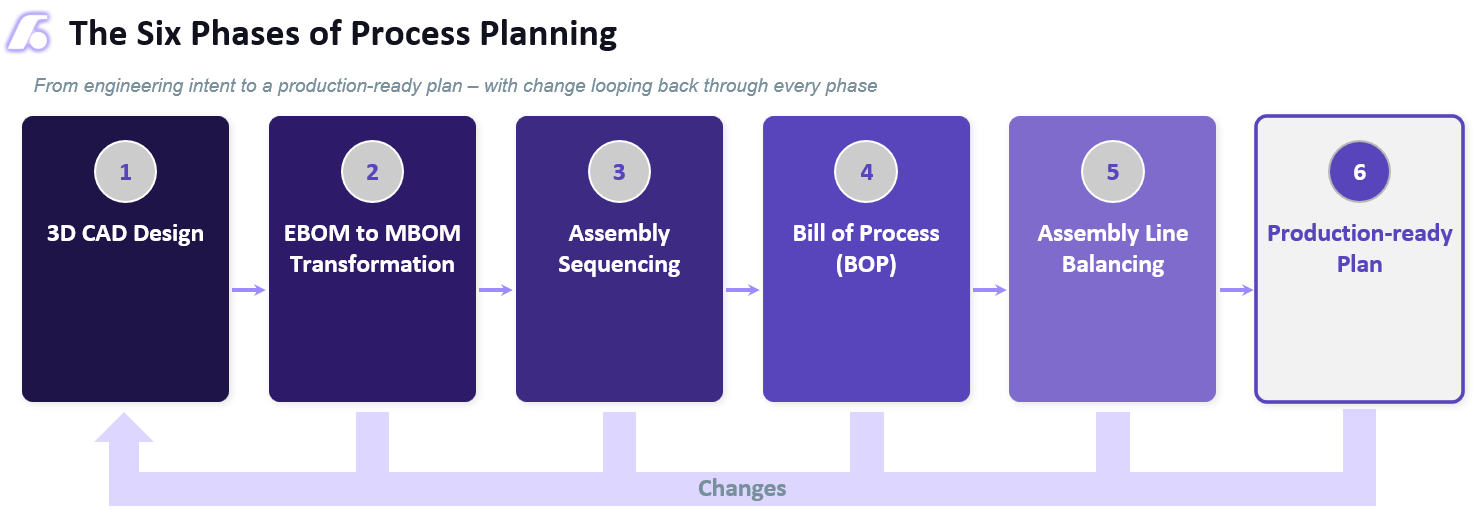
It's a fair question. At its core, process planning has six phases: 3D CAD Design, EBOM to MBOM Transformation, Assembly Sequencing, Bill of Process (BOP), Assembly Line Balancing, and the Production-ready Plan. Manufacturers have poured real investment into the pillars on either side of that chain: PLM, ERP, MES, CAD. Assembly sequencing, sitting right in the middle, never got the same treatment. It became the thing done between systems, not in one.
The Current Process: Spreadsheets and Tribal Knowledge
In most organizations, assembly sequencing still lives in Excel, built by a small group of specialists who carry the logic in their heads more than in any system. A few things kept it that way.
Even the vocabulary works against it. In a manufacturing context, “sequencing” just as often means just-in-time, just-in-sequence (JIS) delivery, a logistics discipline about getting parts to the line in the right order, as it does the actual order in which parts and subassemblies get put together. Two different problems sharing one overloaded word, and it doesn't stop there. Assembly planning also forks early into manual and automated paths, often owned by different functions with different tools and incentives: a manufacturing or industrial engineer planning a manual station, a robotics or automation engineer planning a robotic cell. And where dedicated software did show up, it usually arrived as an extension of PLM: BOP support bolted onto a system built for engineering data management, with workflow and change management as the value-add. Useful, but adjacent to the core problem rather than built for it.
None of this happened for lack of ambition. Assembly sequencing runs on judgment calls, geometric reasoning, and physical intuition that are genuinely hard to reduce to fixed rules, and that's exactly the kind of problem traditional, deterministic software struggles to codify. That's a large part of why the tool of record stayed a spreadsheet: not because no one tried to build something better, but because the logic resisted being turned into software. It's also why the shift toward AI matters here. Reasoning over 3D geometry and assembly logic, instead of just storing and routing data, is a different kind of software problem, and one that's finally tractable.
Where It Breaks Depends on Where You Sit
How hard this is depends on where you sit in the supply chain. For an OEM launching a genuinely new program, feasibility is the hard part from day one. The end product is often different enough from its predecessor (new architecture, new content, new materials) that historical sequences don't transfer cleanly, and there's no tribal-knowledge shortcut to fall back on. Proving out a sequence by hand can take months before a single feasible plan is achieved.
That gap, months of manual feasibility work against a business that increasingly can't wait months, is exactly where digitizing assembly sequencing earns its keep. Automating the process doesn't just speed up documentation; it collapses the initial feasibility effort from months down to weeks, with checks that are instantly validated as the design evolves instead of once at the end of a study.
It looks different for a tier supplier iterating on a part that's close to the last generation. Arriving at a feasible sequence usually isn't the hard part there. Tribal knowledge and historical precedent get a team there quickly enough. The cost shows up when something changes:
- Introduce automation or robotics, and a geometry change made to accommodate a robot arm can invalidate the sequence built around a manual process.
- A non-model change, a BOP modification for instance, can just as easily break a sequence that depends on assumptions baked into the BOM.
- Either kind of change cascades downstream. Work instructions don't update themselves, and companies are effectively wishing they would.
The bottom line: a single unforeseen change can push time to production back by months. Worse, an error introduced by manual, hunch-based sequencing can run into millions in rework.
Why This Is a Priority Now, Not Later
The pressures aren't new, but the stakes are higher. Consumer demand for personalization is pushing product complexity up, and more product complexity means more process complexity. Time-to-market pressure is real in every vertical, whether it's an automotive OEM compressing its development cycle or a consumer electronics company racing to be first. And cost pressure hasn't eased either: rework, scrap, and excess labor hours all come directly out of margin, and the expectation is to find those savings without adding headcount.
Put those pressures against a process still running on spreadsheets with no live connection to the CAD, the BOM, or the BOP, and the gap between what the business needs and what the tooling supports is only going to widen.
The Takeaway
Assembly sequencing isn't a side task between the BOM and the BOP. It's where product complexity, manufacturing method, and organizational responsibility all collide. Treating it as a connected, first-class step in process planning, rather than an offline exercise that feeds a static document, is what keeps the digital thread intact from engineering intent to production reality.
If assembly sequencing at your company still lives in spreadsheets and tribal knowledge, and you're curious what a connected approach looks like, reach out to us at info@foundationegi.com.